
09 Oct 2026
Statistics
Domestic undergraduate application statistics at early bird closing 2026
Applications for tertiary study in 2026–27 opened on Wednesday 8 April 2026 and early bird applications closed at midnight on Wednesday 30 September 2026. (Students can still apply after this date, but they pay a higher processing charge.)
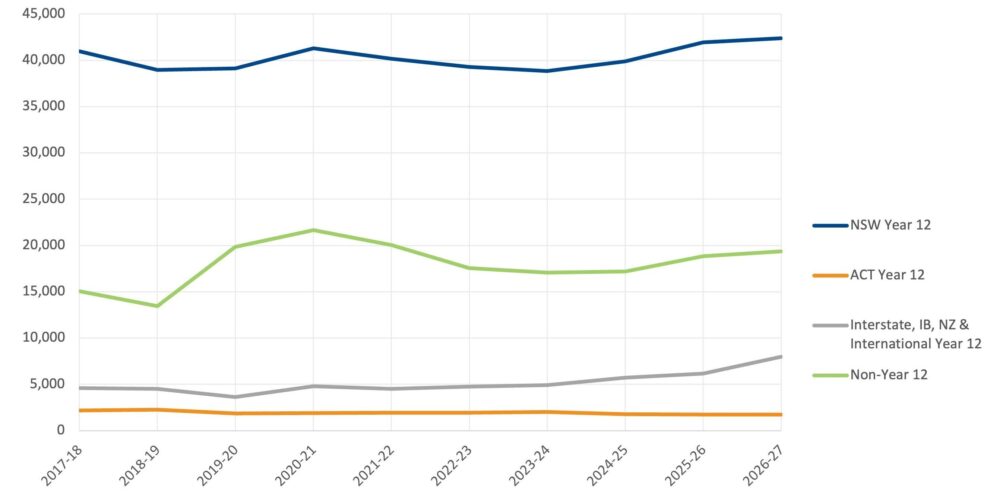
UAC received 71,464 domestic applications for undergraduate study in the first six months of the 2026–27 admissions year, 2,812 (4.1%) more than by early bird closing last year.
Many students have also applied directly to individual universities for study next year to maximise their chances of receiving an offer. UAC has processed another 84,111^of these applications on behalf of individual universities.# These applications are not included in the following analyses.
^Applicants may apply directly to several universities, so this figure is not the count of unique applicants, but the number of applications received.
#UAC processes direct applications on behalf of Australian Catholic University, Australian College of Physical Education, Australian National University, CQUniversity Australia, Macquarie University, University of New England, University of Newcastle, University of Tasmania, University of Wollongong, UNSW Sydney, and Western Sydney University.
Download the 2026 early bird closing statistics
Application analysis
Applications by applicant type
Applicants are divided into four categories: NSW Year 12s; ACT Year 12s; interstate, International Baccalaureate, New Zealand NCEA and international students studying an Australian Year 12 qualification; and non-Year 12s.
Please note that from this admissions period, New Zealand and international Year 12 applicants are now classified under the Interstate and IB category, rather than the Non-Year 12 category.
Applications at early bird closing by applicant type: 2017–18 to 2026–27
Gender analysis
The gender split of applicants this year shows that 56.3% of Year 12 applicants were female, the same as last year, while 59.1% of non-Year 12 applicants were female, up 2% on last year.
Age analysis
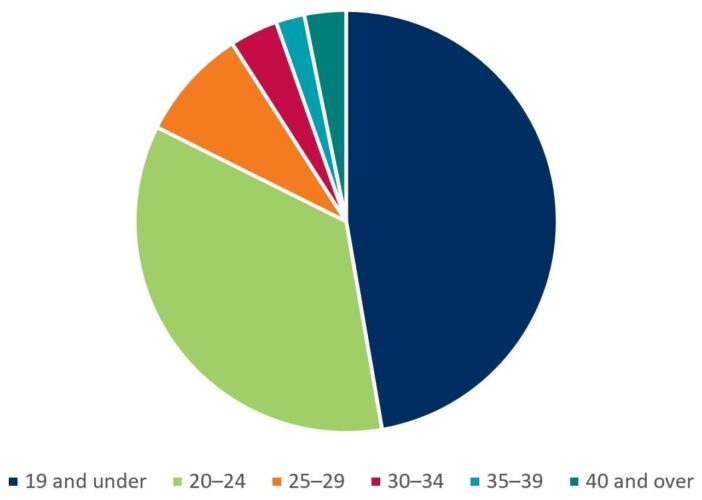
As in previous years, almost all Year 12 applicants were 19 years old and under (99.8%). Around 82.4% of non-Year 12s applicants were 24 years old and under.
The breakdown by age group for non-Year 12 applicants is shown in the following chart.
Non-Year 12 by age group: 2026–27
First preference analysis
Domestic undergraduate applicants can choose up to five course preferences. Their first preference is the course they would most like to study.
First preferences by field of study and applicant type
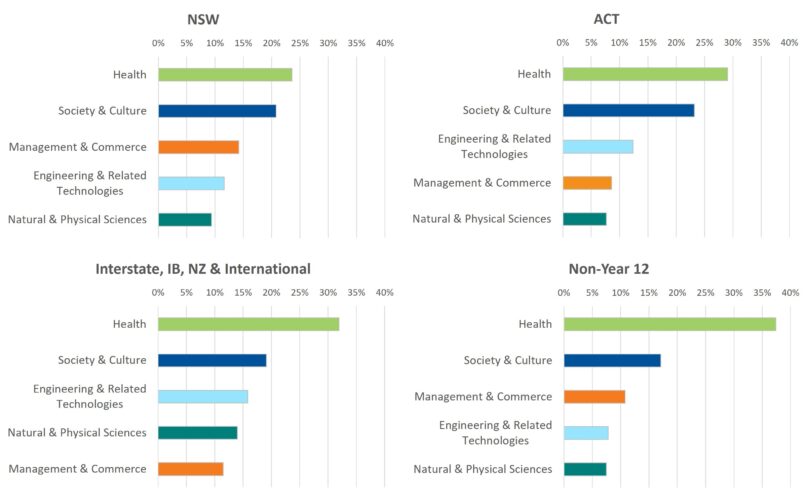
The top five fields of study listed as first preferences by NSW and ACT Year 12 applicants were similar. Both groups had most first preferences in Health and then Society & Culture. The next three top preferences were in Management & Commerce, Engineering & Related Technologies and Natural & Physical Science, but ordered differently.
For non-Year 12 and other Year 12 (interstate, International Baccalaureate, New Zealand NCEA and international students studying an Australian Year 12 qualification) applicants, most first preferences continued to be in Health, followed by Society & Culture.
Overall, Health has again taken the top spot as the favoured field of study, with 28.4% of early bird applicants listing it as their first preference. Society & Culture came second, receiving 19.6% of first preferences across all applicant types.
Field of study by first preferences and applicant type: 2026–27
First preferences by field of study and gender
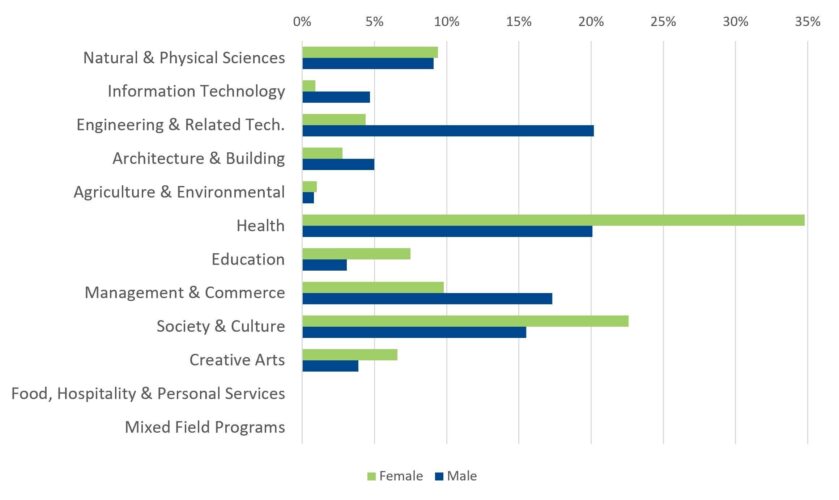
Both females and males had most first preference courses in Health following on from 2025 data. Similarly, the spread of first preference courses across fields of study was more even for males than for females.
Over half of female applicants listed their first preference course in either Health (34.8%) or Society & Culture (22.6%). In contrast, popular fields of study for males included Health (20.1%), Engineering & Related Technologies (20.2%), Management & Commerce (17.3%), and Society & Culture (15.5%).
Compared with males, a smaller proportion of females had first preference courses in Engineering & Related Technologies, Management & Commerce, Information Technology, and Architecture & Building.
Field of study of first-preference courses by gender: 2026–27
Compare the domestic undergraduate application statistics at early bird closing 2025.